

 7 min of reading
7 min of reading
7 min of reading
Operation Diaspora. Ads interfering in Moldovan elections came from Poland
Pro-Russian groups recruited Moldovan citizens to monitor polling stations, according to Moldovan investigative journalists. We have established that many threads in this scheme lead to Poland.


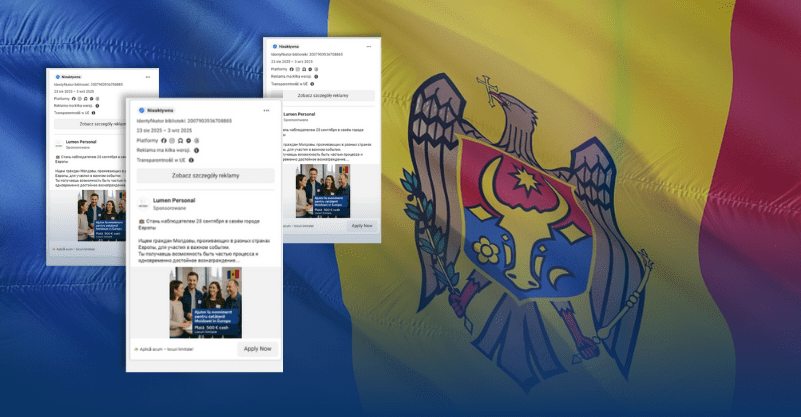
Pro-Russian groups recruited Moldovan citizens to monitor polling stations, according to Moldovan investigative journalists. We have established that many threads in this scheme lead to Poland.
The stakes in Sunday’s elections in Moldova were high – the country’s citizens had to choose between further integration with the European Union and a shift towards Russia. Ultimately, the pro-European Party of Action and Solidarity won with the support of over half of the voters. The Patriotic Electoral Bloc, oriented on cooperation with Russia, came in second with 24.25 percent of the vote.
Two days before the elections in Moldova, we alerted about potential attempts to interfere in the electoral process. We have previously written about how the country has been the target of numerous propaganda and disinformation campaigns by Russia, and in our podcast, an expert from Ośrodek Studiów Wschodnich (eng. the Center for Eastern Studies) explained that pro-Western and pro-Russian sentiments are clashing in Moldova.
Shadow play
During the pre-election period, Moldova was of particular interest to Russia, which had repeatedly attempted to influence the political situation in that country in the past. The situation was no different before Sunday’s elections. Russia went on the offensive, using troll farms, propaganda, and disinformation (1, 2, 3) to try to tip the scales in favor of the party it favored.
Activities were also carried out outside the country. It turns out that Facebook ads were used to recruit independent election observers from among Moldovans living outside their homeland. Their task? To look for any irregularities at polling stations. At least in theory.
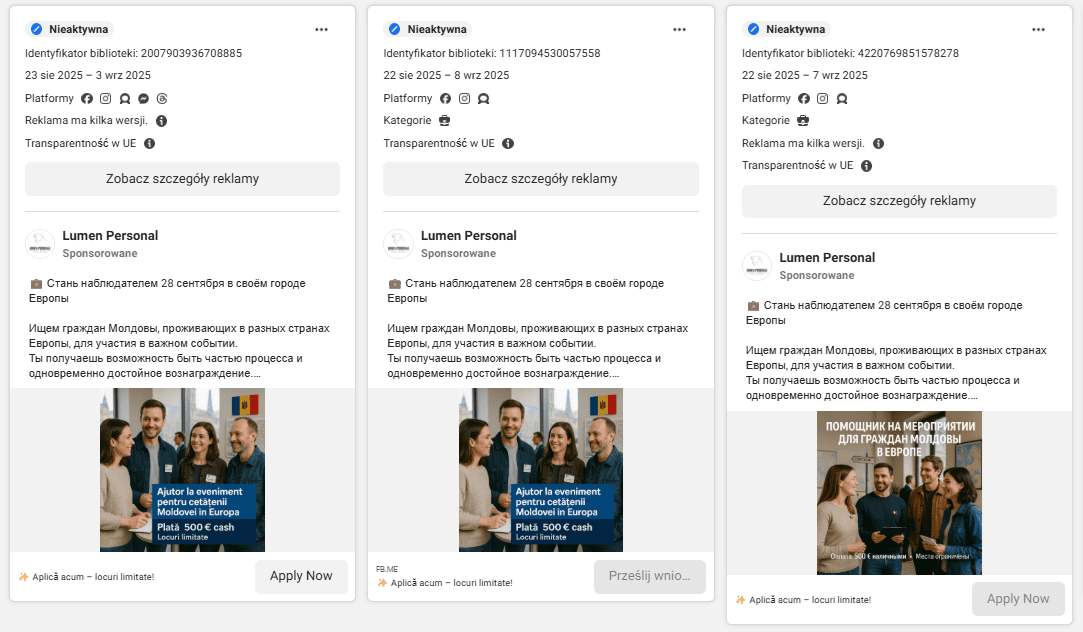
Source: Screenshot from Meta’s Ad Library. The ad description reads: “Become an observer on September 28 in your European city. We are looking for Moldovan citizens from various European countries to participate in an important event. You will have the opportunity to be part of the process and receive decent compensation.” The ad promises €500 in cash..
The problem is that this was not an official, internationally recognized election observation mission (e.g., on behalf of the OSCE). The identity of the organizers was unknown, instructions were sent by telephone, and participants were misled about their role. At the recruitment stage, they believed they were working for one of the Moldovan parties. And the money was most likely paid to them without any contract.
From Poland, through Europe, to Transnistria
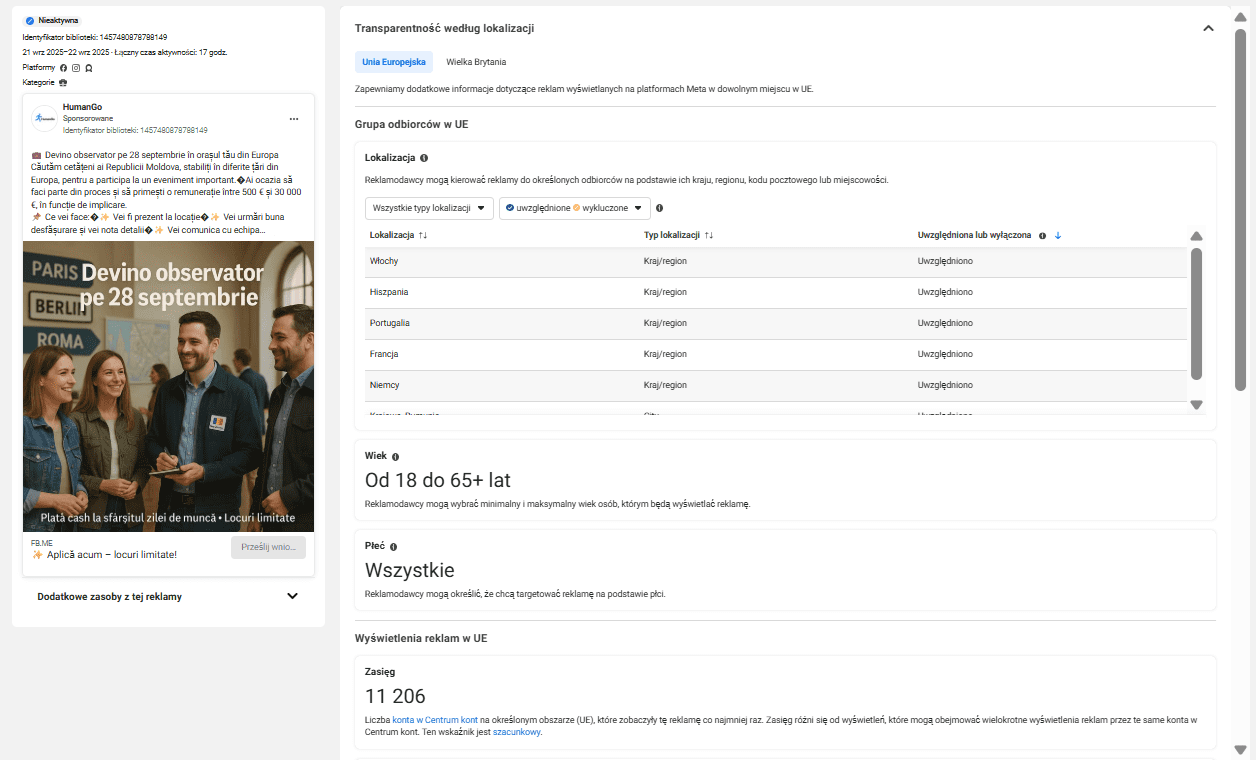
Source: screenshot from Meta’s Ad Library. The ads were targeted at people in many EU countries.
The case was highlighted by investigative journalists from Anticoruptie.md. They remarked that grassroots observers were one of the “surprises” during the elections foreshadowed by Ilan Shor, an oligarch based in Moscow who had already been involved in Russian political interference in Moldova in the past.
Thanks to the findings of Moldovan analysts, we have insight into how the observers worked (1, 2, 3). Qualified individuals were added to a group on WhatsApp, Viber, or Telegram, where they received instructions. The organizers promised them large rewards for “monitoring the integrity of the electoral process.” The aim may have been to gather material to undermine the election results if they proved to be contrary to the interests of pro-Russian circles (1, 2, 3) or to carry out provocations at foreign polling stations.
Investigative journalists from Ziarul de Gardă discovered a direct Russian connection. Their findings show that reports from polling stations were collected in one place – on a server belonging to a company operating in the separatist region of Transnistria. What is more, this company is managed by the Neculițî brothers, who, under the umbrella of Stark Industries, have been involved in hacker attacks in Ukraine and the European Union in the past (1, 2, 3, 4). Investigations to date indicate that Stark Industries was a platform supporting Russian cybercriminal groups.
The trail from Moldova leads to Poland. Who is the owner of AdvertPro?
Investigations by Moldovan journalists and analysts into Russian influence operations led us to Poland. Thanks to the option to check information about ads on Meta platforms, we discovered that the company paying for them is called AdvertPro, and its headquarters are located in Poland. The business is registered to a Ukrainian, Oleh

Source: screenshot from Meta’s Ad Library. AdvertPro Digital Agency is the beneficiary and payer of the ads in question.According to our findings, Oleh works in marketing and specializes in running advertising campaigns on platforms such as Meta Ads (including Facebook). The man does not hide online – he openly runs his businesses and social media accounts (1, 2, 3).
Oleh’s business paths: from Polish employment agencies to Moldovan connections
AdvertPro has several locations – although this is not unusual in the case of a sole proprietorship. The Polish Ministry of Finance lists an address in Stara Iwiczna under the company’s tax identification number. Meanwhile, its now-inactive website lists a location in Warsaw.
Thanks to the man’s data, we discovered that he is also a member of the board of Phoenix Services Group. According to the REGON online database, the company is involved in labor recruitment activities. This is where the first connection between Oleh and Moldova appears – the president of the board of this company is Moldovan, Simion Javgurean.
The Moldovan citizen is also a member of the management board of Pako Group HR, which operates not only in Poland but also in Moldova. Pako Group HR is an employment agency that is legally registered in that country. PAKO HR and Pako Jobs Agency are active companies with similar names and almost the same management. Oleh worked for Pako Group HR from 2019 to 2021.
Employment agencies for foreigners and… the Association of Russian Compatriots in Poland?
Most of the companies we have mentioned offer services that are the same or similar to those of employment agencies, and their target group is immigrants. Following the trail of companies associated with Oleh’s circle, we came across another interesting lead.
The Moldovan’s partner in companies with “Pako” in their names is a Polish man Paweł Kot who also holds shares in Almac Group. Ksawery Staniszewski, who was the treasurer of the now dissolved Association of Russian Compatriots in Poland – SSR Galicya, is also involved in this company. The Pole is also the president of the board of another employment agency for foreigners – SunGroup HR Agency.
HumanGo’s Moldovan connections – how did the account operate before the elections?
The Moldovan thread also surfaced when we searched for information about the HumanGo Facebook account. It was under this profile that Facebook ads were shared seeking “independent” observers in the Moldovan elections.
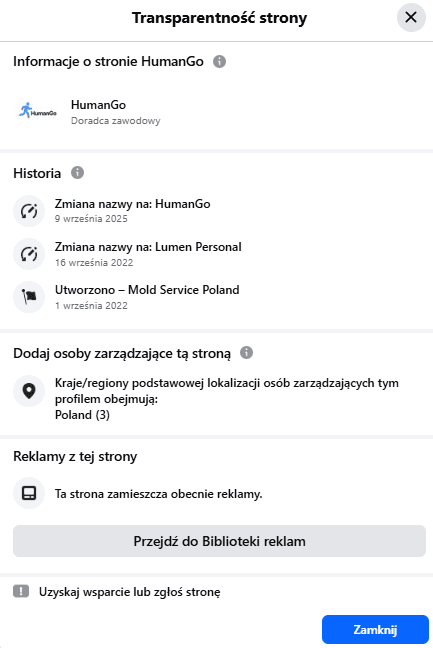
Source: screenshot from the HumanGo profile on Facebook. In the past this page was called Lumen Personal and Mold Service PolandWe have established that the profile was created in 2022 under the name Mold Service Poland. According to Krajowy Rejestr Sądowy (eng. the National Court Register), the owners of this company are individuals with both Romanian and Moldovan citizenship – Nicolae Senciuc oraz Luminita Senciuc. The later name of the company, Lumen Personal, is also managed by a woman with a Moldovan passport.
We found unfavorable opinions from former employees of Mold Service Poland, which clearly indicate that it was another employment agency acting as an intermediary between foreigners and employers.
Russian disinformation also present in Poland
We do not know whether Oleh consciously participated in a pro-Russian campaign aimed at influencing the credibility of the elections in Moldova. We tried to contact him, but at the time of publication, he had not responded to our emails on this matter.
For many years, Russia has been conducting activities in cyberspace aimed at influencing public opinion. Undermining the results of democratic elections is one of the goals of the Kremlin’s organized activities. Therefore, the information we have gathered has been submitted to the relevant authorities.
We were drawn to look into this matter by information received from the Spanish fact-checking organization Maldita.es. We would like to express our sincere thanks. We would also like to thank the analysts at Stopfals.md for their consultation on the Moldovan aspects of the case.
*If you find an error, highlight it and enter Ctrl + Enter

RECOMMENDED