

 7 min of reading
7 min of reading
7 min of reading
International Links of the Smilk Brand. We Have Submitted Our Findings to the European Authorities
In cooperation with our international partners, we examined the operations of substitute milk brands linked to the Polish manufacturer Smilk. Our findings indicate that the composition and promotional methods used for these products raise serious concerns.


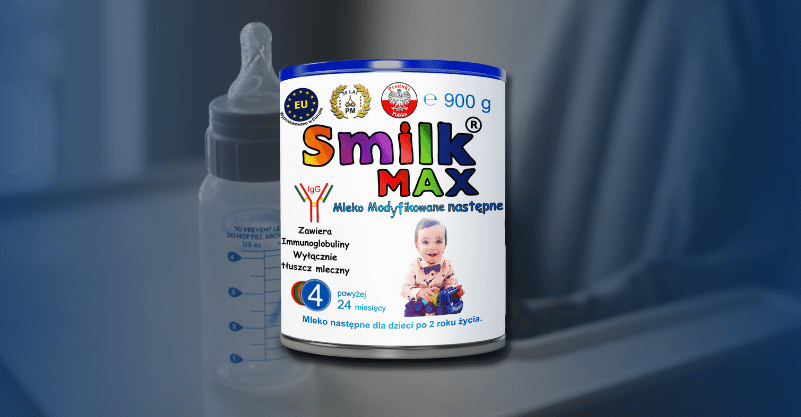
In cooperation with our international partners, we examined the operations of substitute milk brands linked to the Polish manufacturer Smilk. Our findings indicate that the composition and promotional methods used for these products raise serious concerns.
A few weeks ago, we reported on the legal issues of the producer of the Smilk infant formula brand, associated with Prof. Grażyna Cichosz. Notably, the product remains available for purchase online, despite the brand’s owners having informed sanitary authorities that it was being withdrawn from the market.
As previously reported, the brand’s owners rely on pseudoscientific theories – including alleged harms of vegetable fats or fish oils (1, 2, 3) – to stir anxiety about competing products and promote their own, which may not comply with EU requirements.
The brand’s owners are under investigation by the Polish Sanitary Inspectorate (Sanepid) and the District Prosecutor’s Office in Bydgoszcz. Following the publication of our article, Deputy Speaker of the Senate Magdalena Biejat submitted a letter to the Prosecutor General requesting special oversight of the case.
It has now emerged that similar substitute milk products are also being marketed outside Poland.
In collaboration with fact-checkers from Slovakia’s Demagog and Belgium’s public broadcaster VRT NWS, we examined brands linked to the Polish producer. Our findings show that sales and promotional practices surrounding these products raise concerns similar to those seen with Smilk in Poland.
Smilk Products Sold in Belgium Without Sanitary Oversight – in Breach of Regulations
A former employee of the company behind Smilk told us that the Polish manufacturer’s partners are also selling the controversial formula abroad. In Belgium, it is distributed by Tolcetach, a company operating as a consulting firm.
As in Poland, Belgian regulations require that the relevant authorities be notified before infant formula is placed on the market. However, local sanitary officials informed us that the Belgian distributor of Smilk did not fulfill this obligation. We verified this independently by examining publicly available registry data.
The brand’s products in Belgium are available exclusively online, mirroring the distribution strategy used in Poland. On the Belgian Smilk distributor’s website, we found information confirming that the product being sold in Belgium originates from the Polish manufacturer.
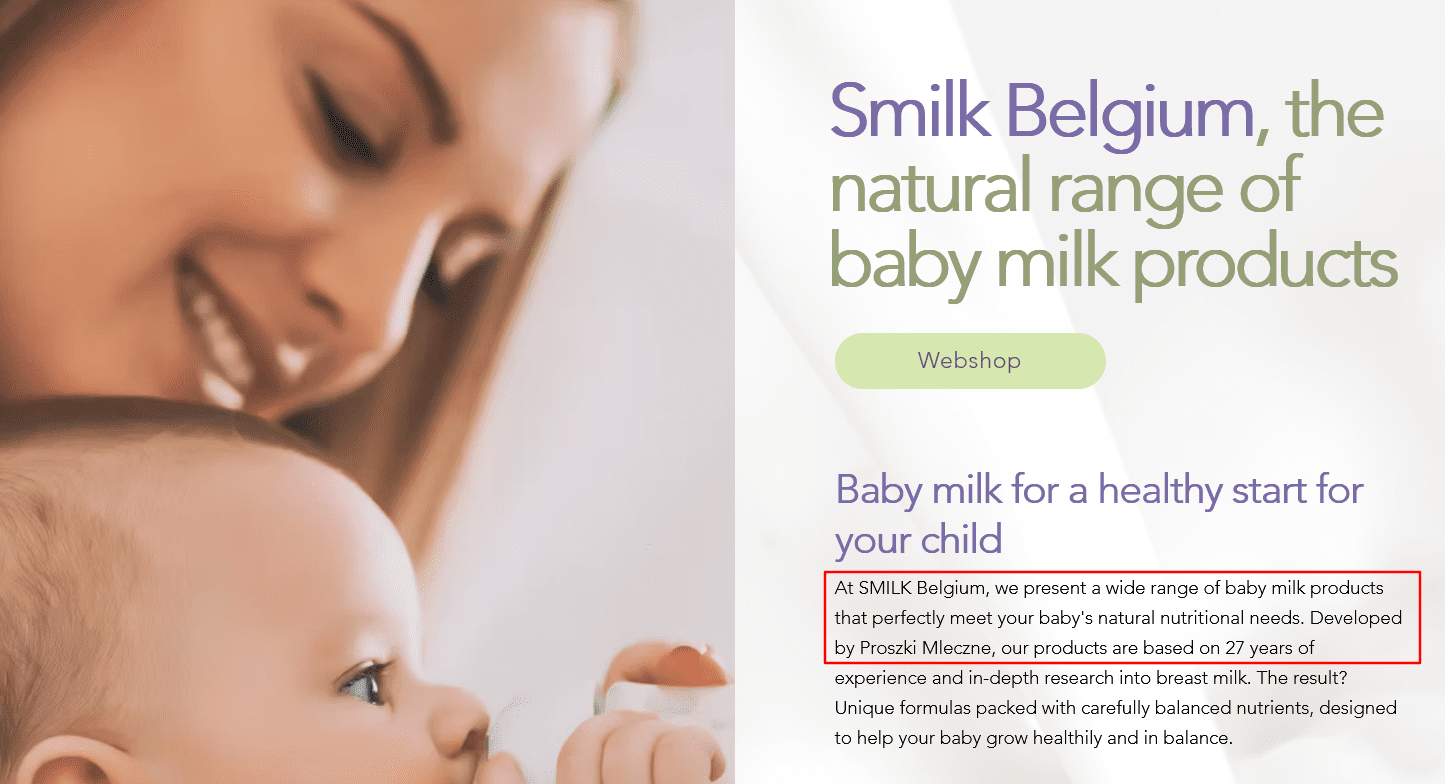
Source: smilk.be, modified by Demagog
Concerns Regarding Labelling and Product Composition
Annelies Wynant, spokesperson for the Federal Public Service for Health, Food Chain Safety and Environment (FPS), notes that the composition and labeling of some Smilk products do not comply with EU regulations.
“The composition of the product ‘SMILK lactose-free’ does not comply with European legislation. Its protein content is too high. Furthermore, glucose has been added, which is not permitted in this type of product.”
The Belgian Smilk website also contains content that violates Belgian rules on the promotion of products intended for infant nutrition.
“No infant formula may be compared to breast milk. The Smilk.be website includes several claims that are prohibited in the promotion of such products.”
Moreover, claims suggesting Smilk milk is “similar to breast milk” also appear on the brand’s Polish Facebook page (1, 2, 3).
According to Wynant, the website places disproportionate emphasis on problems associated with breastfeeding while omitting the benefits of breast milk. “This approach is inconsistent with the regulations governing proper information dissemination,” Wynant states.
In response to our report, the Belgian health authorities informed us that they are considering opening an investigation into the company distributing Smilk in Belgium.
Slovak BabySmilk – A Brand Recognized from TV
In Slovakia, a related brand known as BabySmilk is marketed – and unlike its Polish and Belgian counterparts, it is available in physical retail stores. Michal and Tatiana Domin, a couple identifying themselves as the brand’s “founders,” appeared on a popular television program where they promoted claims about the alleged harmful effects of vegetable fats used in competing products.
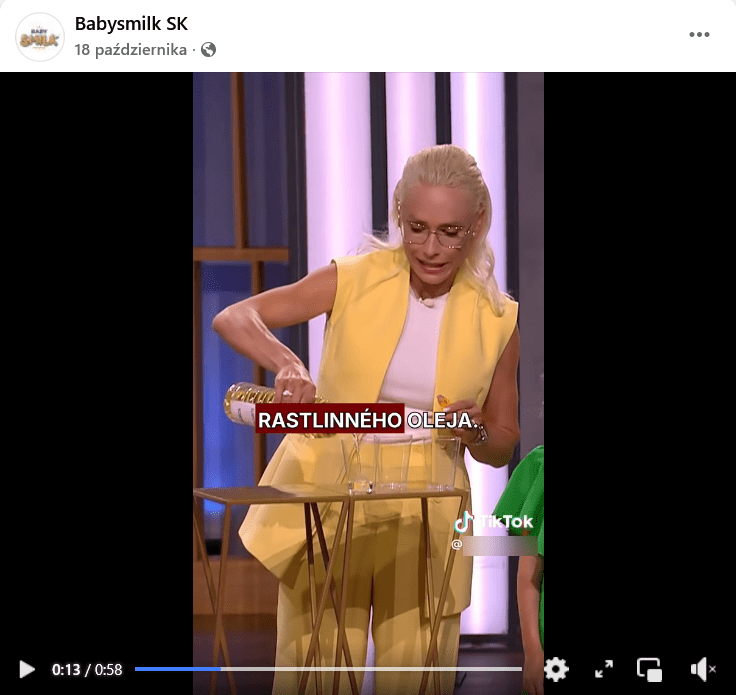
Source: Facebook, 18.10.2025
We also identified similar claims on BabySmilk’s official Facebook page (1, 2). One post warns: “Attention! Do not buy infant formula containing vegetable oils. Sooner or later, your children may experience problems, including gastrointestinal inflammation and neurological disorders.”
The Slovak website also asserts that scientific studies by Prof. Grażyna Cichosz confirm the product’s health benefits. However, we found no such research in scientific repositories or digital libraries (1, 2, 3). As reported earlier, Cichosz is connected to the Smilk brand and may have contributed to its co-creation. This suggests that the Slovak BabySmilk brand is likely linked to the Polish manufacturer.
Following the publication of our article, ÚVZ informed us that inspection proceedings had been initiated regarding BabySmilk products, including an inquiry into the brand’s connections with the Polish manufacturer.
Milk Made Solely from Cow’s Milk Ingredients Is Not Suitable for Infants
As in Poland, the Smilk and BabySmilk formulas sold in Belgium and Slovakia consist – according to their declared compositions – exclusively of ingredients derived from cow’s milk (1, 2, 3, 4).
However, scientific research (1, 2, 3) shows that such a product cannot meet legally defined requirements, including those related to polyunsaturated fatty acid content, and is therefore unsuitable for infant consumption.
Prof. Hanna Szajewska, MD, PhD, head of the Department of Pediatrics at the Medical University of Warsaw, explains that cow’s milk alone does not provide all the essential nutrients in the quantities and proportions necessary for an infant’s proper growth and development:
“Vegetable fats (including soybean oil) are added in order to: (1) compensate for the very low level of polyunsaturated fatty acids in cow’s milk fat (only 2-4 percent of all fatty acids); (2) ensure an adequate supply of essential fatty acids – linoleic acid and alpha-linolenic acid – in the amounts recommended by EFSA [European Food Safety Authority]; (3) reduce the proportion of saturated fatty acids typical of dairy fat. Fish oils (and algal oils) are essential because neither cow’s milk fat nor typical vegetable oils contain long-chain polyunsaturated fatty acids such as docosahexaenoic acid (DHA). EFSA considers DHA necessary for the proper development of the brain and visual system, which is why its addition to infant formula is recommended. Experts continue to debate whether only DHA should be added, or arachidonic acid (ARA) as well […]”
Smilk’s websites and social media channels feature claims suggesting that the brand’s products comply fully with legal requirements for infant formula composition (1, 2). According to Prof. Szajewska, this is not possible:
“A formula composed solely of cow’s milk and its fat cannot be considered compliant with existing standards for lipid composition and would not provide the essential nutrients necessary for an infant’s proper development.”
We Have Notified Authorities in Six More Countries
Our investigations in Poland, Slovakia, and Belgium indicate that Smilk’s sales and promotional practices may violate sanitary regulations and consumer information standards in other markets where the brand operates. Given the scope and nature of these operations, we concluded that it was necessary to alert sanitary authorities in every country where Smilk products were identified as being sold.
We notified authorities in the Czech Republic, Hungary, France, the Netherlands, Kazakhstan, and Egypt.
We emphasized that similar irregularities have been identified across three independent regulatory systems – Poland, Slovakia, and Belgium – which provides reasonable grounds to suspect that comparable violations may also occur in local markets within these six countries.
We will continue to report on any actions taken by the relevant foreign institutions as new information emerges. Together with our international partners, we will continue to monitor Smilk’s activities.
Translated from Polish by Julia Kędziorek
*If you find an error, highlight it and enter Ctrl + Enter

RECOMMENDED