

 5 min of reading
We debunk false information that appears on social media and websites. We verify the most harmful examples of disinformation by referring to credible sources.
5 min of reading
Drone attack as a “Ukrainian provocation”? Beware of the false narrative
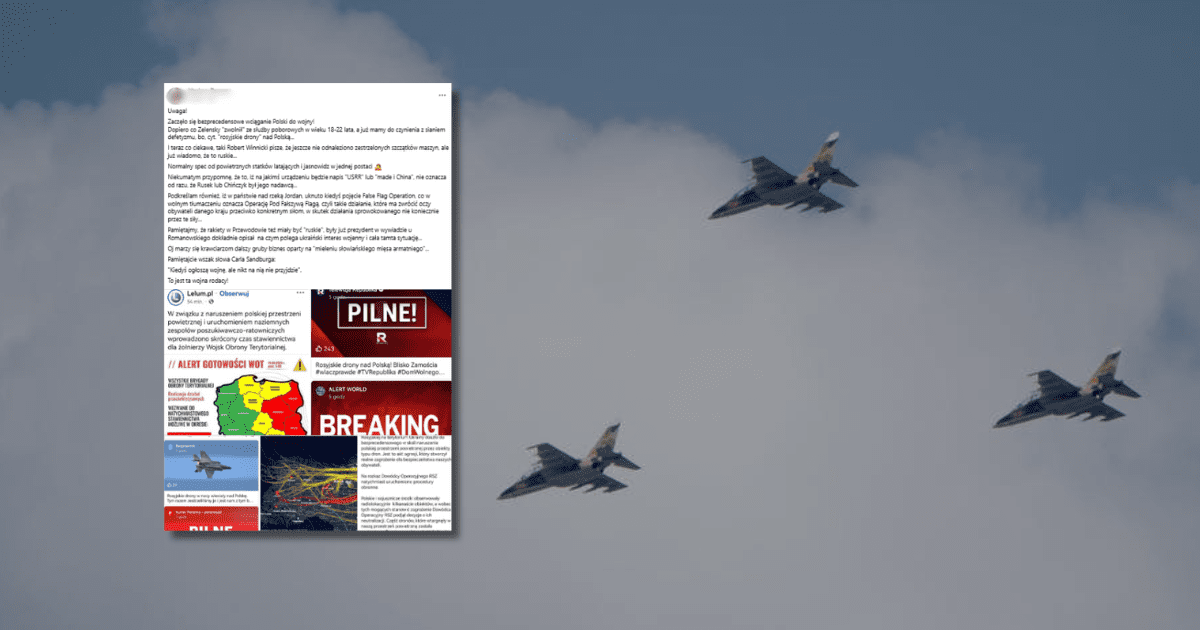
During the night, Polish airspace was violated by Russian drones. Online once again, claims are circulating that it is Ukraine trying to drag Poland into the war. This is a return of a false narrative that has existed since the very beginning of the war.
Fot. Pexels / Facebook / Modyfikacje: Demagog
Drone attack as a “Ukrainian provocation”? Beware of the false narrative
During the night, Polish airspace was violated by Russian drones. Online once again, claims are circulating that it is Ukraine trying to drag Poland into the war. This is a return of a false narrative that has existed since the very beginning of the war.
Fake news in a nutshell
- Posts on social media (1, 2, 3) claimed that the flight of Russian drones over Poland on the night of September 9–10 was a Ukrainian provocation. Some argued that it was a reaction to the statement of the Polish president, who refused to allow Polish soldiers to be deployed to Ukraine.
- There is no credible evidence that the recent events in Poland were caused by Ukraine. All available information indicates that the drones flying over Poland were Russian machines, not Ukrainian military equipment.
- Narratives about a “provocation” are a recurring disinformation theme – they also appeared earlier after the incident in Osiny. At that time, the prosecutor’s office dismissed those claims.
The first violation of Polish airspace occurred on Tuesday at 11:30 p.m. More drones were later spotted over Poland. Around 5:30 a.m. on Wednesday, the Operational Command of the Polish Armed Forces (DO RSZ) reported that some of the objects had been shot down.
The drone intrusion into Polish territory was linked to a Russian attack on Ukraine. In the morning, Polish authorities responded. After consultations with President Nawrocki, Prime Minister Donald Tusk announced that he was considering triggering Article 4 of the NATO treaty. According to its wording: “The Parties will consult together whenever, in the opinion of any of them, the territorial integrity, political independence or security of any of the Parties is threatened.”
As news spread about the drones being shot down, social media accounts started promoting claims that this was a Ukrainian provocation (1, 2, 3). Posts on Facebook included statements such as: “last night several Ukrainian drones crossed into Poland” and accusations that Polish media were lying about their origin. Another user suggested the events were a response to President Karol Nawrocki’s words [original spelling]: “Nawrocki said yesterday he won’t send troops to Ukraine, and strangely enough, this morning Ukrainian drones are already flying into Poland, destroying a residential building.”
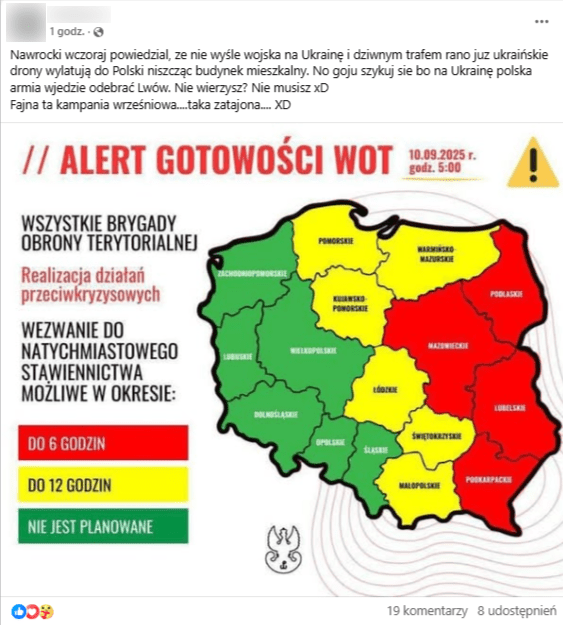
Source: Facebook.com, 10.09.2025
Similar claims appeared on TikTok. In one video, we could hear that “Banderites are sending drones over Poland” [timestamp 0:03] and that Ukrainian President Volodymyr Zelensky is “a loser” who therefore carries out “new provocations” [timestamp 0:20].
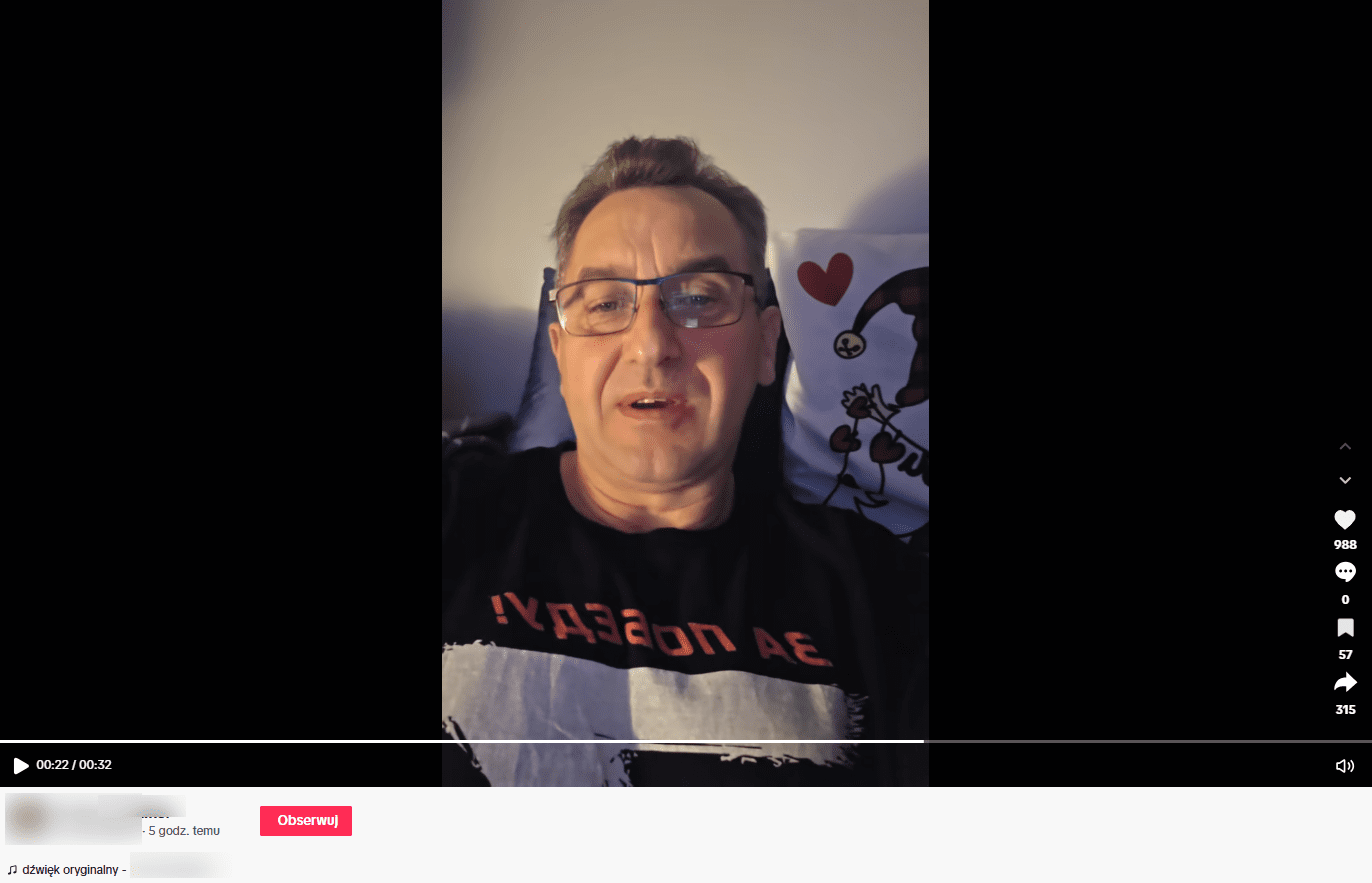
Source: Tiktok.com, 10.09.2025
Speculation about Ukrainian responsibility also appeared in comments. Some wrote directly that Poland’s airspace had been violated by drones seized by Ukrainians in a deliberate act. Others speculated it might have been a response to Nawrocki’s remarks.
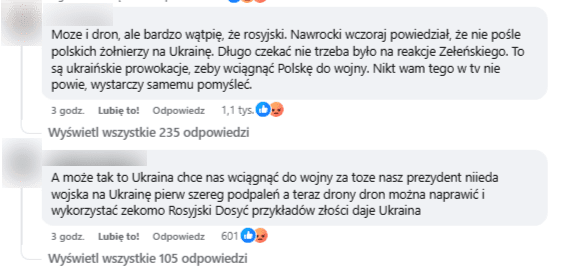
Source: Facebook.com, 10.09.2025
No evidence that the drone incursion was a Ukrainian provocation
None of the official sources state or even suggest that the drones shot down over Poland were Ukrainian equipment. The Armed Forces reported a “violation of Polish airspace” following a Russian attack on Ukraine. Polish politicians, including Prime Minister Donald Tusk, also confirmed the presence of Russian drones. In parliament, Tusk additionally stated that the drones had come from Belarus, not Ukraine:
“For the first time during this war (the drones came) not from Ukraine, as a result of errors, disorientation of drones, or small-scale Russian provocations. For the first time, a significant portion of these drones came over Poland directly from Belarus.”
The drone attack is not linked to the president’s statement
Some social media posts also suggested that the drone incident was connected to President Karol Nawrocki’s statement. During his visit to Finland, the Polish president said that he did not intend to consent to sending Polish soldiers to Ukraine.
However, the president’s statement did not differ from earlier communications by the prime minister, the Ministry of National Defense, or other Polish politicians. Those statements were not followed by drone attacks. Based on such reasoning, no connection can be drawn between Nawrocki’s words and the recent events.
The “provocation” narrative is an old theme in new form
This is not the first time that claims of a Ukrainian provocation surfaced after a Russian drone intrusion into Poland. Similar accusations appeared after the August 20, 2025, incident in Osiny, when fragments of military equipment fell there. The District Prosecutor’s Office in Lublin, which is investigating the case, stated at the time that there was no evidence that the equipment was Ukrainian.
“At this point, I cannot confirm whose property the drone was. However, regarding the circumstances of an alleged provocation, it must be stated that no evidence gathered in the investigation so far indicates such circumstances.”
This analysis was created as part of a project co-financed by the Polish-American Freedom Foundation under the We Support Ukraine program, implemented by the Education for Democracy Foundation.
*If you find an error, highlight it and enter Ctrl + Enter

RECOMMENDED