

 4 min of reading
We debunk false information that appears on social media and websites. We verify the most harmful examples of disinformation by referring to credible sources.
4 min of reading
House in Wyryki destroyed by a storm? We are investigating
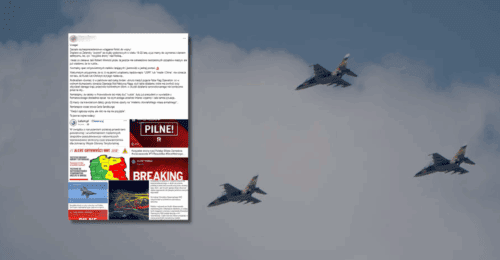
One of the most widely discussed topics after the violation of Polish airspace was the house in Wyryki – damaged when one of the drones crashed. Online reports circulated claiming that the photos from the site were actually related to a storm.

Źródło: Interia Wydarzenia/modyfikacje: Demagog
House in Wyryki destroyed by a storm? We are investigating
One of the most widely discussed topics after the violation of Polish airspace was the house in Wyryki – damaged when one of the drones crashed. Online reports circulated claiming that the photos from the site were actually related to a storm.
FAKE NEWS IN A NUTSHELL
- Posts on Facebook claimed that the house in Wyryki was not destroyed by a Russian drone crash, but by a storm. As “proof,” screenshots from online publications were shared, juxtaposing images from the scene with headlines about heavy rainfall.
- The photos used in these posts come from articles on the Interia Wydarzenia and Eska.pl portals. According to a statement we received from a representative of ZPR Media Group, the mismatch between photos and incorrect headlines could have resulted from a Google search engine error.
- Other news outlets, including the Polish Press Agency, Polsat News, and Radio Lublin, published reports from the site. Their materials contain alternative shots of the damaged building, confirming the authenticity of the incident.
Many false claims and narratives have been circulating regarding the violation of Polish airspace by Russian drones – several of which we have already analyzed (1, 2, 3).
The news about the destruction of the house in Wyryki-Wola attracted significant attention. According to the District Prosecutor’s Office in Lublin, which is investigating the case, the building was damaged by an “unidentified flying object,” which has not yet been classified as a drone or its fragment. Some, however, insist that the destruction happened under different circumstances. Social media posts (1, 2, 3) claimed that the house had supposedly been damaged months earlier during a storm and that the photographs did not show current events. Screenshots (1, 2, 3) were posted as “evidence,” showing the house alongside headlines from weather-related news articles.

Source: Facebook, 11.09.2025
Some of these posts (1, 2, 3) quickly gained popularity – one received over 300 reactions. It attracted more than 100 comments, some of which suggest that users believed the disinformation. [original spelling]: “Good job. TVN lives in some bubble and thinks no one will call them out,” “Exactly, the damage looks like from a tornado, not from a plastic drone.”
Articles about the storm do not include photos of the Wyryki house
One of the widely shared screenshots (1, 2, 3) shows the headline of an article from Interia Wydarzenia. However, in the article “Storms and heavy rains in Italy. Gale hit Emilia-Romagna,” there are no images of the white-brick building seen in the viral posts (1, 2, 3). These images are also absent from the archived version of the article published at the end of August 2025.
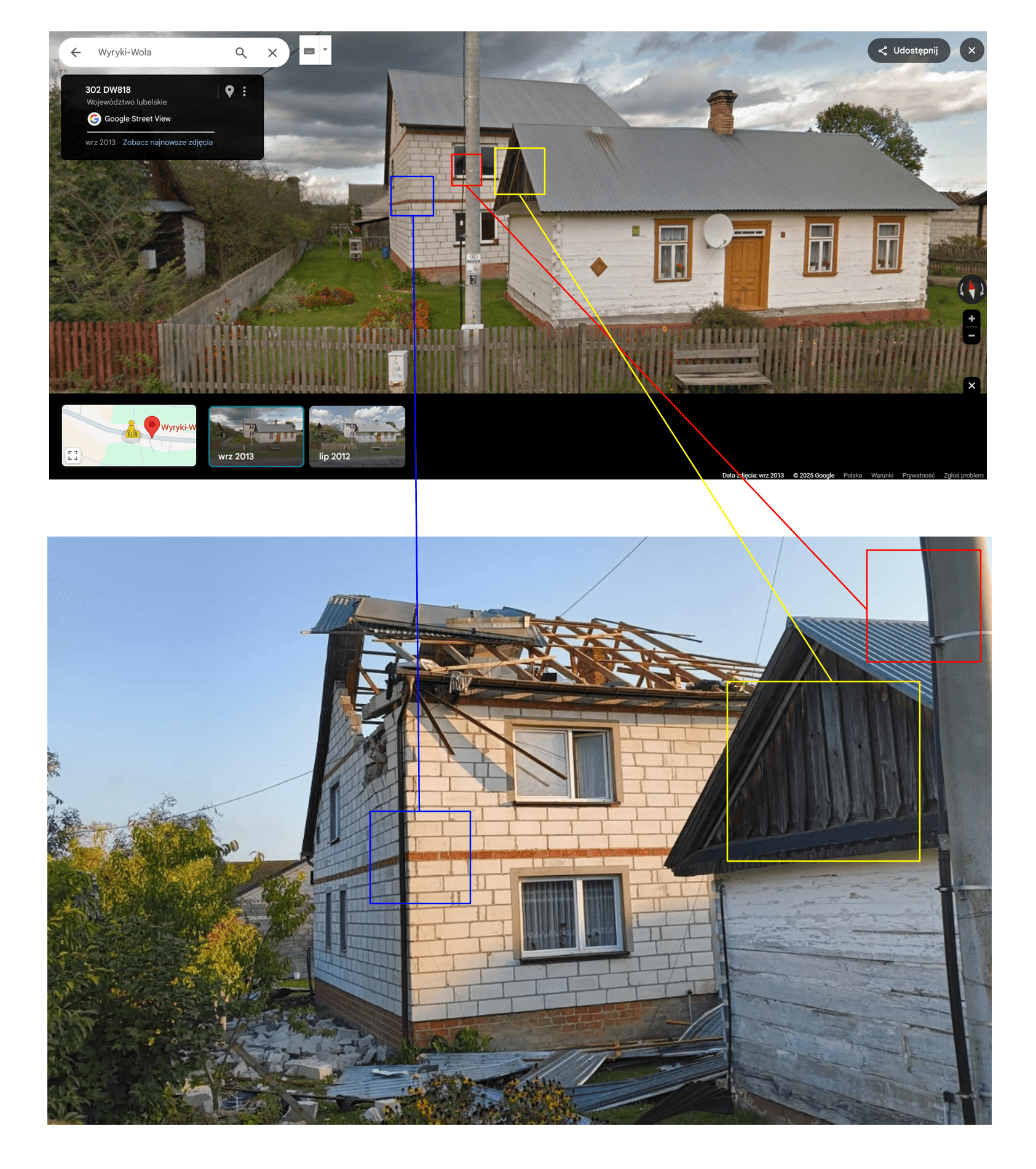
Using Google Maps, we can confirm that the building in the photos is indeed located in Wyryki-Wola, Poland, not in Italy, where the weather events described in the article took place.
Why did the photos appear with old headlines?
The photos of the damaged house seen in posts (1, 2, 3) come from articles published on the Interia Wydarzenia and Eska.pl portals (1, 2). The mismatch between these images and unrelated headlines likely resulted from a Google search engine error. In a statement we received from representatives of ZPR Media Group, which owns Eska.pl, the company explained:
“The problem of incorrect image-to-text attribution appears only in Google search, where the algorithm mistakenly assigns an image to an article and then displays it incorrectly in the search results. This is entirely independent of online publishers, including ZPR Media Group. Such misattribution most often results from the fact that the search algorithm relies on a complex set of signals to interpret and choose the most representative image, which are not always clear-cut. These include context, file name, alt text, or the image’s quality and size. As a result, the search engine sometimes assigns a graphic from a completely different article that happens to be on the page at the time, e.g., in the ‘other/recommended/you may also like’ section […]”
As Interia explained in its own publication, the close-up photos used there were submitted to the editorial team by a reader. The author of the photographs in the Eska article is Arkadiusz Michlewicz, co-author of the text.
Other evidence of authenticity
In publications by other outlets reporting on the consequences of the Russian attack (including the Polish Press Agency, Polsat News, and Radio Lublin), we can see alternative shots from the site, showing the damaged white-brick building. These materials confirm the authenticity of the entire incident.
*If you find an error, highlight it and enter Ctrl + Enter

RECOMMENDED